Inclined sleeping and CCSVI are more than just a theoretical association. In my daily clinical practice, they represent a real opportunity for improvement in patients dealing with neurological and autonomic symptoms that often defy explanation. These symptoms tend to worsen at night, intensify when lying flat, and ease when standing. Sleep posture is never neutral — for some people, it can change everything.
Over the years, I’ve heard dozens of similar stories: sudden awakenings with palpitations, pressure behind the ears, a feeling of intracranial congestion, nighttime restlessness — and in some cases, full-blown vagal episodes. Among these patients — often with a suspected or confirmed diagnosis of CCSVI — a common pattern emerges: lying completely flat tends to make the symptoms worse.
Why is full-body inclined sleeping different?
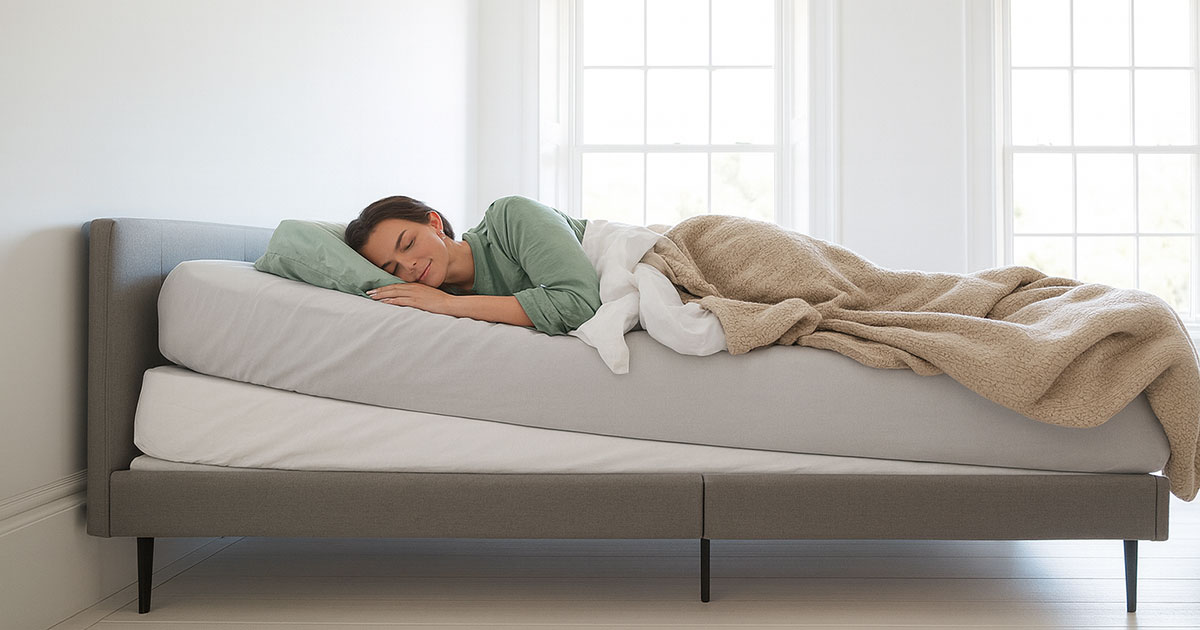
When people hear “inclined sleeping,” they often think it just means using an extra pillow. That’s a mistake. In cases of CCSVI or impaired venous outflow, the truly effective position is one where the entire body is inclined at about 30–35 degrees — evenly, from head to toe.
It’s not about propping up just the upper body — it’s about creating a gentle, continuous slope, as if sleeping on a ramp. This helps to:
- avoid neck flexion or thoraco-abdominal compression,
- promote cerebral venous drainage and lymphatic return from the lower limbs,
- prevent cerebrospinal fluid stagnation in the upper compartments.
Pillows under the head or “V-shaped” inclinations can actually make things worse by creating sharp angles that disrupt venous flow dynamics. In contrast, inclining the entire body as a single unit promotes a physiological, continuous, and stable flow.
Inclined position and CCSVI: what clinical experience reveals
In patients with CCSVI — often also dealing with craniocervical instability, Chiari malformation, Ehlers-Danlos syndrome, or dysautonomia — I’ve found that adjusting sleep posture is one of the most effective, affordable, and non-invasive interventions available.
Those who adopt this strategy often report:
- reduced morning headaches,
- fewer nighttime awakenings,
- a clearer, more focused mind upon waking,
- deeper sleep and better nighttime temperature regulation,
- less nighttime tachycardia or feelings of alarm.
In some cases, the benefits are so significant that inclined sleeping becomes a stable part of the therapeutic routine. It’s not a cure, but a postural adjustment with real therapeutic impact.
How to achieve the correct body inclination
To achieve a proper inclination of the entire body axis:
- you can use an adjustable medical bed,
- place supports under the head-end legs of the bed,
- or buy wedge-style inclined bases (“inclined cradle”) available online.
The recommended inclination is between 25° and 35°, depending on individual tolerance. It takes some experimentation to find the right angle—one where the body feels supported and breathing remains easy and unrestricted.
Important: the entire head-to-toe body axis must be inclined while maintaining proper ergonomic alignment. Any point of bending — at the neck, abdomen, or hips — can negate the benefits or even cause new issues.
Who can benefit from this strategy?
I recommend trying inclined sleeping if:
- your symptoms worsen when lying flat and improve when sitting or standing,
- you feel intracranial pressure at night or pain behind the ears,
- you wake up suddenly with a sense of alarm, tachycardia, or the urge to move your legs
- you’ve already noticed improvement with cervical traction or Acetazolamide,
- you have a diagnosis (or strong suspicion) of CCSVI, Chiari, EDS, CCI, or dysautonomia.
A posture that could change your day
Many patients report a general improvement after adopting inclined sleeping: more energy upon waking, less of that “heavy head” feeling, better temperature regulation, and even a reduction in brain fog.
It’s not a miraculous fix, but for many, it’s a key piece of the puzzle in their path toward improvement.
The connection between inclined sleeping and CCSVI is clinically relevant. We’re not talking about an invasive treatment or an experimental approach, but a simple, accessible adjustment that can significantly improve quality of life.
In my approach, before considering complex therapies, I always start with the body. Observing it, listening to it, and adjusting what may seem trivial — but isn’t: sleep posture. For those dealing with venous or cerebrospinal fluid dysfunctions, the night can become an opportunity for relief. All it takes is sleeping… at the right angle.
📩 Experiencing similar symptoms? You might have undiagnosed CCSVI
If you recognize yourself in these symptoms — headaches that worsen when lying down, pressure behind the ears, sudden nighttime awakenings, nighttime tachycardia, or morning brain fog — there could be an undetected venous issue behind your condition.
CCSVI isn’t easy to detect with standard tests, and it’s often overlooked. That’s why it’s crucial to speak with a physician who truly understands these dynamics.
👉 Get in touch through the contact page at raffaellopagani-ccsvi.it — we can assess whether targeted diagnostic tests are appropriate and determine if your body — even while you sleep — is trying to tell you something. And maybe, just by listening to it more closely, you’ll already start to feel a little better.